ECO Village project

“DESIGN A SUSTAINABLE VILLAGE IN IRELAND FOR 2050”

A SCHOOL-UNIVERSITY-MUSEUM PROJECT IN STEAM EDUCATION
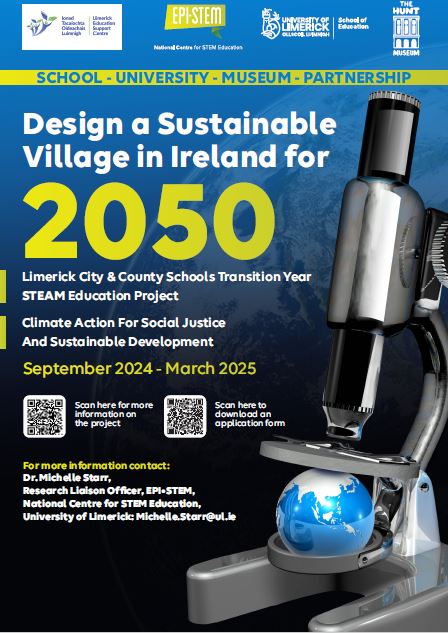
Councillor Pádraig Reale, deputising earlier today for the Mayor of Limerick, Mayor John Moran, officially launched the Awards Ceremony for the DESIGN A SUSTAINABLE VILLAGE IN IRELAND FOR 2050 project in the Foundation Building at the University of Limerick.

These STEAM Education projects were presented as posters, videos and artefacts by more than 40 local pupils coming from six Limerick post-primary schools – Castletroy College, Coláiste Chiaráin, Crescent College Comprehensive SJ, Coláiste Nano Nagle, St. Munchin’s College and Thomond College. The twelve teachers who generously volunteered their time came from a rich diversity of subjects including science, physics, chemistry, engineering, coding, arts, economy and STEM. While most of the participants were from Transition Year, one group of pupils were from second year.

This unique School-University-Museum-Partnership was led by Professor Geraldine Mooney Simmie (Director of EPI•STEM National Centre for STEM Education) and Dr. Michelle Starr (Research Liaison Officer, EPI•STEM), in collaboration with Maria Cagney (Curator) and Emma King (Education Officer) at the Hunt Museum, and Norma O’Brien, Director of the Limerick Education Support Centre.

The pupils were invited to imagine a futuristic village in Ireland for 2050 that puts social justice and environmental justice at the heart of just and sustainable living. The awards ceremony was made possible, by the commitment of teachers and pupils and by the generous sponsorship of five local enterprises, including Analog Devices, Boston Scientific, Eli Lilly, ESB and Serosep. Dermot Bannon, architect and RTE 1 personality has attached here a wonderful video message for the pupils.

Speaking at the Awards Ceremony, Professor Geraldine Mooney Simmie said “We are at a crucial crossroads in Ireland and Europe today, and urgently need ambitious leaders in relation to how we might reimagine and plan for a decentdemocratic society while securing our small part of the planet. The young people today have shown just how innovative they can be when it comes to finding sustainable solutions to the problems of green housing, public infrastructure and energy”.

Caption: Councillor Pádriag Reale deputising for the Mayor of Limerick on Thursday, 27th March at the DESIGN AN SUSTAINABLE VILLAGE IN IRELAND FOR 2050 project at the University of Limerick.
The photograph shows the partners in this school-university-museum initiative and some of the sponsors.
LEFT TO RIGHT: Tom Walsh (ESB), Maria Cagney (Hunt Museum), Norma O’Brien (Director, Limerick Education Support Centre), Emma King (Hunt Museum), Professor Geraldine Mooney Simmie (Director, EPI•STEM, UL), Cllr. Pádraig Reale (Deputising, Mayor of Limerick), Dr. Michelle Starr (Research Liaison Officer, EPI•STEM, UL ), Bernie O’Connor (ESB), and Eamonn Doyle (Boston Scientific).

 

Career Mathways

Career Mathways is a novel and exciting project designed for Transition Year students and teachers. The project was designed by a team of mathematics education researchers based in EPISTEM, the national centre for STEM education. The project was funded under the SFI Discover scheme, which sought to promote the awareness and engagement of the Irish public with science, technology, engineering and mathematics (STEM).

Career Mathways aims to highlight the mathematics underpinning a variety of careers, as a way of enhancing student engagement across all STEM subjects. The project engages with several well-known, high-profile personalities (e.g. Jacqui Hurley [RTÉ Sports Correspondent]; Lizzie Lyons [TV3 Chef & Entrepreneur]; Dean Strang [‘Making a Murderer’ Lawyer]; Joanna Donnelly [Meteorologist, Met Eireann]) and other professionals, who all kindly volunteered their time to act as STEM Ambassadors. There are 17 STEM Ambassadors/careers in total.

Our STEM Ambassadors were interviewed about the ways in which they utilise mathematics in their careers and highlight how important is it to have a good understanding of mathematics and be proficient in the subject. These videos serve to make mathematics more visible and fascinating to students and it is hoped that it will help teachers when faced with the common question “Where will I use this again?” .

The videos underpin a suite of teaching and learning resources including detailed and innovative teaching and learning plans; student workbooks featuring authentic, real-world problems as well as tailored PowerPoint presentations for each lesson, to highlight how valuable mathematics is in a variety of different professions. These resources have been piloted in Transition year mathematics classes in over 20 schools across the country. They are now are available to all teachers of mathematics on the ‘Career Mathways’ tab above.

Career Mathways login

TiME (Time in Mathematics Education)

Dr Niamh O’Meara and Dr Mark Prendergast (Trinity College Dublin, formerly of ) have received funding from the Irish Research Council, under the New Foundations Scheme, to conduct a research project entitled “Is there TiME (Time in Mathematics Education)?” The project will run from March 2015 until August 2016 and will be conducted on a national scale.

The introduction of Project Maths in 2010 has prompted a number of reports and studies to suggest that there is an insufficient amount of time allocated to teaching mathematics in Ireland (Department of Education and Skills, 2011; Cosgrove et al., 2012; Irish Maths Teachers Association, 2012; Jeffers et al., 2013; Beggy and O’Meara, 2014). However, none of these reports have provided concrete evidence of the exact amount of time allocated. Thus the main aim of this project is to investigate such issues surrounding the allocation of time for instruction. The key objectives are to (a) establish the instructional time profile on an evidential basis showing the amount of time allocated to teaching mathematics in second level Irish schools and also how this time varies from school to school, (b) compare this time with other countries whose students are performing significantly better than Ireland in international comparison studies and (c) investigate the prevalence of the practice of mathematics teachers providing extra classes for their students to make up instructional time.

There are numerous potential impacts and benefits associated with this project. It is anticipated that the findings will (1) highlight issues surrounding instructional time allocated to teaching mathematics in second-level Irish schools by international comparisons and (2) draw attention to the prevalence, or otherwise, of other non-official instructional time inputs.

Such findings will have a positive impact on the teaching and learning of mathematics in Ireland. They will:

  • Provide concrete evidence to support a number of reports in recent years which have recommended an increase in the number of mathematics classes per week in second-level Irish schools.
  • Underline the need to standardise the amount of class time currently allocated to the subject in different schools around the country.
  • Highlight the dependence of effective mathematics teaching on voluntary inputs.

Project Team

Dr Niamh O’Meara (Lecturer in Mathematics Education, EPI•STEM)

Dr Mark Prendergast (Associate Professor in Mathematics Education, Trinity College Dublin)

Chain Reaction

Chain Reaction: A Sustainable Approach to Inquiry Based Science Education (IBSE)

Chain Reaction is an FP7 funded project focused on creating a sustainable approach to the use of scientific inquiry in the classroom using a cascading model to facilitate its impact. This project runs from 2013 to 2016 across 12 partner countries and located within UL is the Irish partner involved.

The Chain Reaction model is cyclical in nature so each year the project will recruit new teachers (10 each year) from different schools ensuring a large number of teachers and students are able to participate. The focus in Ireland is to create a professional learning community (PLC) involving teacher educators, in-service teachers, pre-service teachers, practicing scientists and policy makers with the aim of developing a living educational theory (Whitehead 1989) of what teachers believe inquiry to represent in their own classroom context.

After teachers have engaged in interactive IBSE professional development, their students (in the 14-­16 age group) work together to research scientific scenarios. Their work is then summarised in a national “Express Yourself” conference held each year in UL where students present posters related to their investigation and the experience of using an inquiry approach.

Members of the project team in UL facilitate the teachers and students as they conduct their inquiry activities. As well as engaging in the PLC and supporting the students, additional project objectives are to (a) help bridge the existing gap between science teachers and the science education community (b) promote a European teacher network (c) disseminate resources and research on effective practice (d) engage in effective evaluation and reporting.

This project is also unique with the participation of practising scientists. These effectively act as role models to the students with the aim of providing them with an insight into the practice of science in everyday life. Each school is visited by a role model whose work resembles the scientific topic that students carried out their inquiry activities on.

Project Team

  • Joanne Broggy (Epi•Stem)
  • Miriam Doram Hamilton (Junior Cycle for Teachers- JCT)
  • David King (Junior Cycle for Teachers- CT)
  • Louise Lehane (Epi•Stem)
  • Anne O’Dwyer (Epi•Stem)
  • John O’Reilly (Epi•Stem)
  • Maria Sheehan (Professional Development Service for Teachers- PDST)
  • Michelle Starr (Epi•Stem)

We are currently looking to recruit 10 teachers(2 teachers from 5 different schools) interested in enhancing approaches to Inquiry Based Science Education.  All methodologies used are coherent with the revised science syllabus and the work is conducted as a community of practice that emphasises sharing ideas in a truly developmental process.  The school is paid directly for your participation and everything is written up by the Chain Reaction (CR) team in a folder that captures the learning for School Self Evaluation purposes.  The work is based in EPI*STEM, the national centre for STEM education, located within the  University of Limerick where we hold the national conference to decide on a team of students and teachers to represent Ireland at an international conference that will be held in Bulgaria. We recruit nationwide, travel expenses are met and hotels are offered for overnight stays where needed.

The ideal class to do this with is TY but we have worked with 1st years in the past.  Previous teachers have reported on this as a very enjoyable experience and as a significant professional development opportunity.  If this is something you think you might be interested in or if you would like more information  please give John O’Reilly a call on (087) 2201305. For further information you can also visit the following websites www.chreact.eu or www.ul.ie/chainreaction.

The Gender Gap Project

A Global Approach to the Gender Gap in Mathematical, Computing, and Natural Sciences: How to Measure It, How to Reduce It?

A multidisciplinary and multicultural project funded by the International Science Council.

Global Survey of Mathematical, Computing, and Natural Scientists.

The 2018 Global Survey of Scientists will target 45,000 respondents in seven languages. The results will help inform interventions to increase participation in STEM fields, especially for women. Please contribute to the survey
https://statisticalresearchcenter.org/global18

Joint Data-backed Study of Publication Patterns.

The project will analyse publication patterns in several scientific fields across countries and regions.

Database of Good Practices for Girls and Young Women, Parents, and Organizations.

An online database will collect effective initiatives to enhance the participation of girls and women in science and mathematics.

WiSTEM2D Project

The WiSTEM2D Project launched in 2015 with the aim of increasing representation of women in STEM2D fields. This initiative supports and inspires female students of all ages in pursuit of careers and their studies in STEM2D. In its third year now, the programme in Ireland is underpinned by 13 global partnerships with academic institutions in the US, Japan, and South America.

In 2016, the University of Limerick and Johnson & Johnson formally launched their significant collaborative education programme to support and encourage women to pursue educational opportunities in STEM2D (Science, Technology, Engineering, Math, Manufacturing and Design). This programme focuses on the university sector, with the goal of supporting female students as they progress to STEM2D careers.

The programme consists of WiSTEM2D Awards and Team Project Awards. Both programmes provide opportunities for students to meet with female role models from industry, be mentored by Johnson and Johnson industry leaders, visit various J&J worksites and develop their peer networks. The WiSTEM2D programme is focused on developing and implementing high impact strategies to support female students undertaking STEM2D degree courses. It aims to build on UL’s ongoing work and to expand the reach and quality of STEM education in third level.

The project aims to assist female undergraduate students investigating issues that hinder female students participating in STEM at undergraduate level and pursuing a career in STEM field.

The project also aims to understand the experiences of Irish female students participating in STEM2D programmes through research conducted by EPI*STEM, the National Centre for STEM.

STEMChAT

SFI has awarded EPI•STEM, the National Centre for STEM Education an award of €35,880 for it’s project ‘STEMChat’. STEMChAT – Women as catalysts for change in STEM education (UL) – looks at the recruitment of female undergraduate STEM Champions and industry mentors who will facilitate informal workshops with school students and parents, predominantly in disadvantaged areas. This project develops innovative approaches to address the serious under-representation of women in the STEM workforce in Ireland. By creating new, engaging approaches to providing career information for school students and parents, our project will address barriers to STEM careers experienced by females that were identified in the 2016 report on STEM Education in the Irish School System: The distinctive feature of our project is the recruitment of female undergraduate STEM Champions and industry mentors who will facilitate informal, small-group workshops with school students and parents, predominantly in disadvantaged areas. Resource packages based on these workshops will be developed and disseminated to participating schools and career guidance counsellors. Our approach capitalises on the successful partnership between EPI•STEM (University of Limerick) and Johnson and Johnson – the WiSTEM2D programme (https://www.ul.ie/news-centre/news/more-female-role-models-needed-in-stem), which empowers females studying STEM in third level by increasing their STEM networks, connecting them to STEM industry role models and debating gender stereotypes in STEM.